

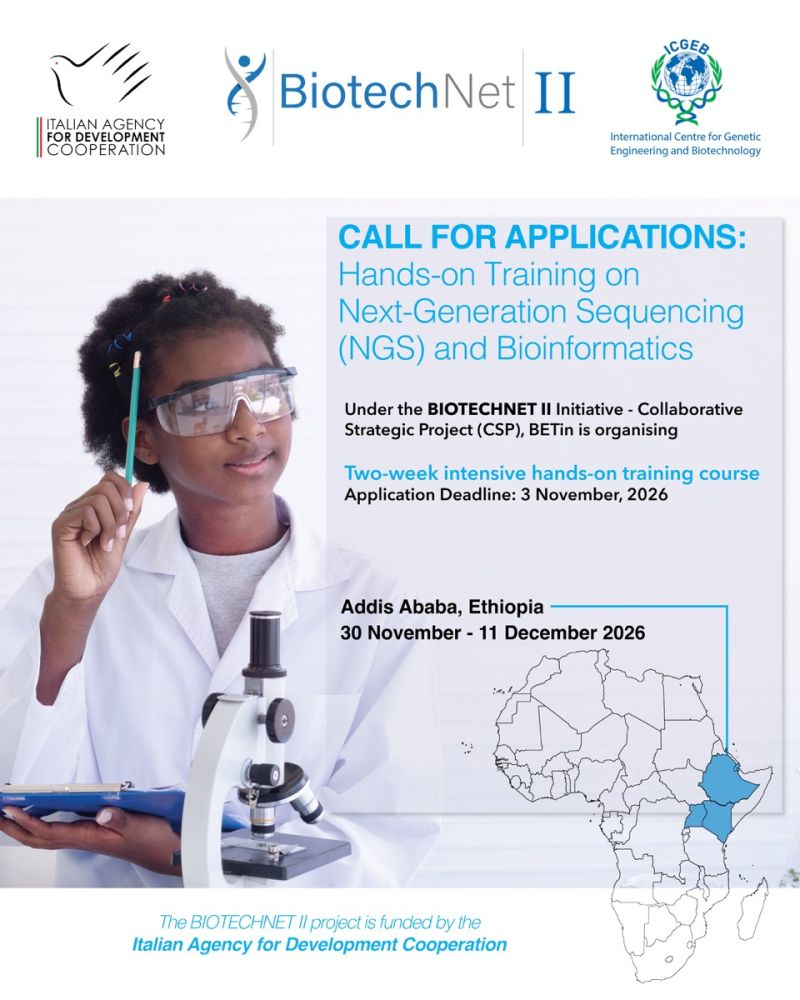
Applications are invited for the Hands-on Training on Next-Generation Sequencing (NGS) and Bioinformatics, a two-week intensive training programme scheduled to take place from 30 November to 11 December 2026 in Addis Ababa, Ethiopia.
The training is organised under the BIOTECHNET II Initiative – Collaborative Strategic Project (CSP) and is designed to strengthen regional scientific and technical capacity in next-generation sequencing, genomics and bioinformatics.
| Programme: | Hands-on Training on Next-Generation Sequencing (NGS) and Bioinformatics |
| Training Dates: | 30 November – 11 December 2026 |
| Location: | Addis Ababa, Ethiopia |
| Eligible Countries: | Uganda, Ethiopia, Kenya and Djibouti |
| Application Deadline: | 3 November 2026 |
The programme provides participants with intensive practical exposure to Next-Generation Sequencing (NGS) and bioinformatics, covering key stages of the genomic workflow from sample preparation and sequencing to computational analysis and interpretation of genomic data.
The course places strong emphasis on practical learning, with approximately 70–80% of the programme dedicated to laboratory and computer-based exercises. Practical sessions will be complemented by focused lectures, demonstrations, troubleshooting sessions and assessments.
The training aims to strengthen participants' ability to apply modern sequencing and bioinformatics techniques to scientific research and pathogen genomic surveillance, including applications within a One Health framework.
Participants will gain practical knowledge and skills that can support genomic research, pathogen characterisation, surveillance, outbreak investigation and genomic epidemiology within their respective institutions and countries.
The call is open to eligible scientists and laboratory professionals from Uganda, Ethiopia, Kenya and Djibouti.
The programme is particularly relevant to scientists, researchers, laboratory professionals and early-career professionals working or studying in areas related to:
The programme will bring together a limited cohort of 10 scientists and laboratory professionals drawn from Ethiopia, Kenya, Uganda and Djibouti.
Eligible Ugandan scientists and professionals are therefore encouraged to submit their applications early and ensure that all required information and supporting documentation are provided before the application deadline.
Through the programme, participants are expected to strengthen their technical and analytical capacity in genomics and bioinformatics and contribute to building sustainable genomic capabilities within their home institutions.
The training is organised under the BIOTECHNET II Initiative – Collaborative Strategic Project (CSP) involving the Bio and Emerging Technology Institute (BETin) and the International Centre for Genetic Engineering and Biotechnology (ICGEB).
The BIOTECHNET II project is funded by the Italian Agency for Development Cooperation (AICS) and supports the strengthening of scientific competencies and institutional capacity in the Life Sciences across participating countries.
Applications must be submitted online through the ICGEB Service Gateway.
Applicants should access the official call below and follow the application instructions provided by ICGEB. Applicants will be required to use the ICGEB Service Gateway to complete and submit their application.
Applicants are advised to review the official ICGEB call for the complete application requirements, selection criteria and any subsequent updates before submitting an application.